Showing posts with label Vegetarian. Show all posts

Friday, July 27, 2012

Grilled Eggplant Lasagna

I was just wandering around the farmer's market near me, gathering the usual things I buy... onions, tomatoes... you know, the normal stuff.  Then I saw them.  The most beautiful dark purple, almost black, eggplant... aubergine if you prefer.

When I had a BBQ at my disposal, I used to love marinating slices of eggplant in olive oil and balsamic vinegar and grilling it.  Some of my friends would make it into baba ganoush - there is nothing like homemade baba ganoush.  My mom makes an eggplant caponata that is amazing.  And of course, there's always eggplant parmesan.  Eggplant is just so versatile.

I will also mention that when I was in Scotland with some dear friends, there was an Indian restaurant below our flat that made the most amazing eggplant recipe... I only wish I could remember the name or find the recipe, because it was a taste of heaven on a fork... I'm not kidding... absolute heaven.

Now... with all those wonderful ideas running around my mind, I bought 2 aubergines to take home and cook.  After a couple days of not being able to make up my mind about what I would turn these beautiful purple nightshades into, I finally decided to make up my own recipe.  So I give you The Lazy Wife's Grilled Eggplant Lasagna.


Normally, I have more pictures, but I wasn't really sure the recipe would turn out that great, so I didn't take pictures till I had the whole thing assembled.  Oh well. 

***

Grilled Eggplant Lasagna

Wednesday, April 6, 2011

Asian Food Kick

I've been craving Asian food recently.  I don't know why... but I want everything with rice, soy sauce, and all those other "typically" Asian tastes and flavors.  I got a jump start on the week when my friend had us over for dinner and served Vietnamese spring rolls.

At least, I've always heard them called Vietnamese spring rolls, they are also known as fresh spring rolls, Vietnamese salad rolls, and sometimes summer rolls.  They look very pretty and are really not so difficult to make.  Ingredients vary based on what you want/like.  My friend made vegetarian rolls, using vegetables she had on hand.  I made mine with chicken.  They make a great meal and can either be pre-made, or you can have your guests make them for themselves.  It would be really fun to have a roll making party, and everyone can put in or leave out whatever they want.


My friend generously gave me the rest of the rice paper and rice vermicelli that she had left over, so I decided that tonight was Spring Roll night.  Really, the only mandatory ingredient is the rice paper, everything else is up to your taste and what you want to put in, quantities are also flexible for whatever size group you have.


Saturday, January 8, 2011

Hummus

My husband was recently bothering me because I had not made hummus last semester.  So, by request, I made hummus today.

Hummus is a Middle Eastern staple food.  When eaten with bread it makes a complete protein, which is awesome especially if you're vegetarian or vegan (though understandably less awesome if you suffer from Celiac disease).  Hummus is actually pretty easy to make.  It relies heavily on taste... so be sure you're tasting as you go.  So, here's my recipe, feel free to play with it and adjust as you like.

***


Hummus, ala the Lazy Wife

1 lb bag dried chickpeas (you can, of course, use canned chickpeas, dried are sometimes cheaper)
Water
1 head of Garlic, minced
The juice of 2 Lemons
1/3 - 1/2 cup Tahini (Sesame seed paste)
1/2 cup Olive Oil
Salt to taste
Optional Hand full of Sun Dried Tomato, Red Pepper, Paprika, Basil, Avocado, Chipotle pepper, etc.

For the Hummus purists (No optional extras):
Soak the dry chickpeas in water overnight.  Drain the old water and cover the now plumped peas with water by about an inch over the level of the peas... it's not important to get the water quantity exact for these steps, just to make sure the peas absorb as much water as they need to become soft.  Bring the peas to a boil, cover and reduce heat to simmer.

My chickpeas have always boil over... but uncovered they smell funny, so choose your poison.
Lower: cooked peas, top left: pea skins, top right: naked peas

Once the chickpeas are soft (30min - 2 hours). It really depends on how much attention I'm paying... when they're soft to the touch (squish one between your fingers after letting it cool and see if it mashes easily) turn off the heat and let them cool.

Hummus with Sun Dried Tomato and dried red pepper
Hummus with olive oil and paprika
When you can handle them, strain the chickpeas and prepare for the "fun" part.  Now, some people just leave them in water and roll them around in their fingers to remove the skins, because the skins, for the most part, rise to the top and can be skimmed off.  I, however, am a perfectionist.  I sit down and watch something while I squeeze the skin off of each and every pea.  My other reason for this is because I do not own a food processor, and mash the peas with a potato masher, and I get a better consistency when I remove every skin.  If you don't care about texture or are blessed with a food processor, then go ahead and remove as much of the skins in whatever way you like.

After removing all the skins, put the peas in a medium to large size bowl.  Add the garlic, lemon juice, tahini, olive oil and some salt, and mash until you get a nice smooth paste.

Some of the ingredient amounts can vary depending on how moist or dry your chickpeas are, and how much you like or dislike certain flavors.  I happen to LOVE garlic, so I used a whole head... just enough to almost give me heartburn.  If you don't like garlic so much, then use 1-5 cloves or whatever you like.

If you find the mashing is not giving you a nice smooth paste, then add a little more tahini, olive oil or lemon juice, depending also on what flavor you think is lacking.  You do have to play with it a little, to get the right taste for your pallet.

If you're feeling a little more adventurous,  you can experiment a little more.

Make the original recipe, but at the end stir in some chopped up sun dried tomato, or some red pepper, or avocado... I know at the farmer's market I used to go to, there was a guy that had all kinds of interesting flavors of hummus.

In most of the Middle Eastern restaurants I've been to, they serve hummus with olive oil and paprika on it.

If you can't find tahini (which I couldn't for a while where I am) I substituted smooth peanut butter!  I know!  Sounds totally crazy, right?!  Well, I did, but I used a little less peanut butter and a little more olive oil and lemon juice, and lots of garlic.  Once it sat for a day in the refrigerator, it tasted pretty much the same as regular hummus, with maybe a little more of a nutty aftertaste.

***

The historical origins of Hummus are unknown.  The earliest verified description of hummus comes from 18th century Damascus.  There were probably similar recipes before the 18th century, and in fact, the Egyptians ate a similar dish that used vinegar instead of lemon juice (which was the ingredient that arrived in the middle east later than all the others).  But it is still unknown where or when hummus, as we know it today, was first made.

Chickpeas are GREAT! Chickpeas are a good source of zinc, folate, and protein.  They have a lot of dietary fiber and are a good source of carbohydrates (especially for people that are insulin sensitive/diabetics).  They also contain phosphorus, magnesium and iron.

Citations: Wikipedia: Hummus, Chickpea

Friday, December 3, 2010

Beans are amazing.

Yup, that's right.  Beans are amazing.  Sometimes I forget just how amazing beans are.

Beans are one of the longest-cultivated plants.  The cultivation of beans even predates ceramics!  Beans were an important source of protein throughout Old and New World history, and still are today. There are over 4,000 cultivated varieties of bean on record in the United States alone.  Certain beans, like Kidney beans are actually toxic, but don't worry because boiling them for at least 10 minutes destroys those toxins.  Another method of destroying the toxins (and making the beans more digestible for humans) is to ferment them.

Today, let's focus on fava beans (also known as: Broad Beans, Bell Beans, Tic Beans, Butter Beans, Windsor Beans, Horse Beans, English Beans, Feve Beans, Faba Beans, Haba or Habas)  These are not to be confused with Lima beans which are sometimes also called butter beans.
  • In ancient Greece and Rome, beans were used in voting; a white bean being used to cast a yes vote, and a black bean for no.  Also, beans were used as a food for the dead, especially during festivals. 
  • In Italy, broad beans are traditionally sown on November 2, All Souls Day. Small cakes made in the shape of broad beans (though not out of them) are known as fave dei morti or "beans of the dead". According to tradition, Sicily once experienced a failure of all crops other than the beans; the beans kept the population from starvation. Some people carry a broad bean for good luck; some believe that if one carries a broad bean, one will never be without the essentials of life. 
  • In Portugal, a Christmas cake called Bolo Rei ("King cake") is baked with a fava bean inside. Whoever eats the slice containing it, is supposed to buy next year's cake.
  • European folklore also claims that planting beans on Good Friday or during the night brings good luck.
Broad beans are rich in tyramine, and should be avoided by those taking monoamine oxidase inhibitors (MAOIs).  Raw broad beans contain the alkaloids vicine, isouramil and convicine, which can induce hemolytic anemia in people with a glucose-6-phosphate dehydrogenase deficiency and can be fatal (also known as "favism").  Though, hemolysis resulting from "favism" may actually act as a protection against malaria.  Broad beans are also rich in L-dopa.  This substance is used medically in the treatment of Parkinson's disease.  It is also a natriuretic agent, which might help in controlling hypertension. 
According to the National Nutrient Database for Standard Reference, one cup of cooked fava beans contains about 187 calories, 1 g of fat, 33 g of carbohydrates and 13 g of protein.  73% of calories come from carbohydrates, 3% from fat and 24% from protein.  They have 9 g of fiber (37% of the daily value).  Fava beans are a rich source of many essential vitamins, especially B vitamins.  Fava beans also contain many essential minerals. They are a good source of manganese, copper, phosphorus, magnesium, potassium and iron.  While fava beans are a good source of protein, the protein they contain is not complete and must be paired with complementary proteins, such as those contained in grain products. 
Alright, I'm sure that's enough information for all of you to realize that beans are really awesome.  Now, on to the recipe.

Citations: Wikipedia: Bean, Vicia faba, Cook's Thesaurus: Dry Beans)

A little background:
A bit over a year ago, I went to Scotland with Opal, her mom, and Rita.  Opal's mom has a jewelry company called Billy's a Bad Kitty, and they had a booth at a Scottish art fair during the Fringe Festival.  There was a little restaurant/cafe next to the art fair.  It carried some pies that we would sometimes eat for lunch.  One of those pies was "Butter bean and Brie Pie."  It was possibly the most wonderful taste experience of my life.  Imagine yourself in an extremely old Scottish cemetery.  It's drizzling rain.  You're a bit cold, wrapped up in warm clothes, and you go into the warm restaurant and buy a single serving pie with a beautifully golden puff pastry shell.  You take it back to the booth.  You cut into the pie with your fork and take a bite.  It's magical.  Buttery crust, perfectly cooked beans, flavorful but not overbearing brie, and a slightly creamy sauce  to tie it all together.

I'm drooling just thinking about it.

Well, I came home and dreamt about that pie.  I was still going through me "I don't like baking" stage, so I let it sit there in the back of my mind... waiting for the right moment to strike.

Life happened, I was home for Thanksgiving, and among the things I was sent back to Davis with (Thank you, Mom), was a 12 oz  bag of dry fava beans.  I couldn't figure out what I was going to do with them until I looked them up online, and found out that they're also called butter beans.  And then the pie sprang into my thoughts.  I went and bought a wedge of brie and some frozen puff pastry (yes, I could have made croissant dough... but I was feeling lazy).  I had all the other ingredients at home.  And so it began.

***

This is the description from Simple Simon's website:
butter beans are casseroled in a vegetable and white wine stock with a good dose of garlic and finished with parsley, cream and lemon juice. Brie is then added to the cooled ingredients prior to baking.

This is what I ended up with (measurements are approximate):

1lb Butter Beans (if you're starting with dried fava beans you'll have to soak them overnight, then blanch them in boiling water for 10min, then cool them and take off the outer shell/thick husk before you boil them with the other ingredients)
2 cups Vegetable stock (chicken broth also works)
3 dashes White wine (I had sherry, and I wasn't going to go buy a bottle of wine just for 1 recipe)
5 cloves Garlic, minced
1/4 large onion, chopped and sauted
1 tsp Parsley
1/4 cup Cream (or 1/2&1/2)
1 Tbsp Lemon Juice
1 largish wedge of Brie cut into chunks


Cook beans in broth, wine and garlic until tender.  Stir in sauteed onion, parsley, cream and lemon juice into Butter bean mixture, let cool.

Preheat oven to 400.  Place puff pastry into a muffin pan (I wanted to make small pies) and spoon mixture in puff pastry shells, cover with more pastry, making sure the pies are sealed around the edges (use water or egg, according to puff pastry directions), bake about 10-15min until golden brown.  (For my pies, I ended up taking the pies out of the muffin pan and flipped them over onto a baking sheet and baked them another 5-10min so the bottoms were also browned and puffy).

***

I know it's cheating, but I really would recommend the Trader Joe's Frozen Puff Pastry... they worked very nicely.  The Husband even commented on how much he liked the pastry shells.

I know I'm going to end up making these again, because they are SO delicious.  Probably for a party this Christmas season.

The Husband is working on getting his finals done for school, so who knows when I'll post next, but I am hoping that I'll have more things to post over the winter break.  For now, I'll leave you with this:

Wednesday, September 22, 2010

Vegetable Soup

Do you have vegetables slowly wilting in your refrigerator?  Don't know what to do with those chicken bones left over from your Friday night dinner extravaganza?  Well, it's time to make some delicious Vegetable Soup!

We had friends over Friday night last week, and it being the first time we'd seen them since the beginning of summer, I decided to roast a chicken.  I thought about killing a fatted calf, but I didn't happen to have one on hand.

The roasted chicken (with sliced vegetables) was a little on the bland side, but once we had finished picking the meat off the bones, I through all the rest of it (bones, skin, and all) into a pot and covered them with water and added some "Poultry Seasoning" from my spice rack.  After simmering for most of a day , I decided that it was done, and strained the broth.  It sat in the fridge for 2 days.  I skimmed off the fat that solidified on the surface.  I left some smaller pieces because we all know that's where the flavor comes from.

Thus I had created: Chicken Stock. 

Now you may be wondering (like I was just a moment ago): What is the difference between Chicken Stock and Chicken Broth?  Aren't they the same thing?

The answer is no.  Chicken Stock is made from the bones and stuff you wouldn't normally eat on the chicken.  Chicken Broth is usually made from the meat.  Stock tends to have a richer flavor because some of the gelatin is released by cooking the bones.  (Thanks, Food Network). For more go here: Wikipedia.

But enough about chicken.  We're making Vegetable soup today!

***

Vegetable Soup
Recipe by The Lazy Wife

1/2 Onion, chopped - I used red, but you could use any kind
1 TBsp Olive oil
4-5 Cloves Garlic, minced
2 medium Potatoes, small cubes - I left the skin on and made the cubes small, potato skin is good for you!
2 stalks Celery, chopped
4 cups Chicken Stock - Chicken broth should work, or make it vegan/vegetarian friendly and use vegetable broth
1/4 cup Sherry
1 large Leek, cut lengthwise and then in strips
2 Mushrooms, diced
10 baby carrots, diced
1 red bell pepper, diced
1/2 cup frozen corn
1/2 cup frozen peas
1-2 cups water
1 Bay Leaf
Salt and Pepper to taste
You know you love the pretty colors!

Wash and cut up your vegetables.  Sauté the onions in a pot with the olive oil and some salt and pepper, add the garlic after the onion is soft.  Then toss in the potatoes, celery, chicken stock and sherry (you could leave this out, but I like the flavor it gives) add water at any point if the broth does not cover the vegetables enough.  After the potatoes are soft (about 15min) use a potato masher to break the potatoes into smaller pieces and give the broth more texture.

Then add the bay leaf, leek, mushrooms, carrots, bell pepper, peas and corn (as I said, empty your refrigerator... you could use whatever vegetables you want in this).

Simmer until the vegetables are soft and serve with some toast or croutons.  You could even put a little bacon on top, or add ham, chicken, rice or barley to it.  It would be very delicious with barley.

***

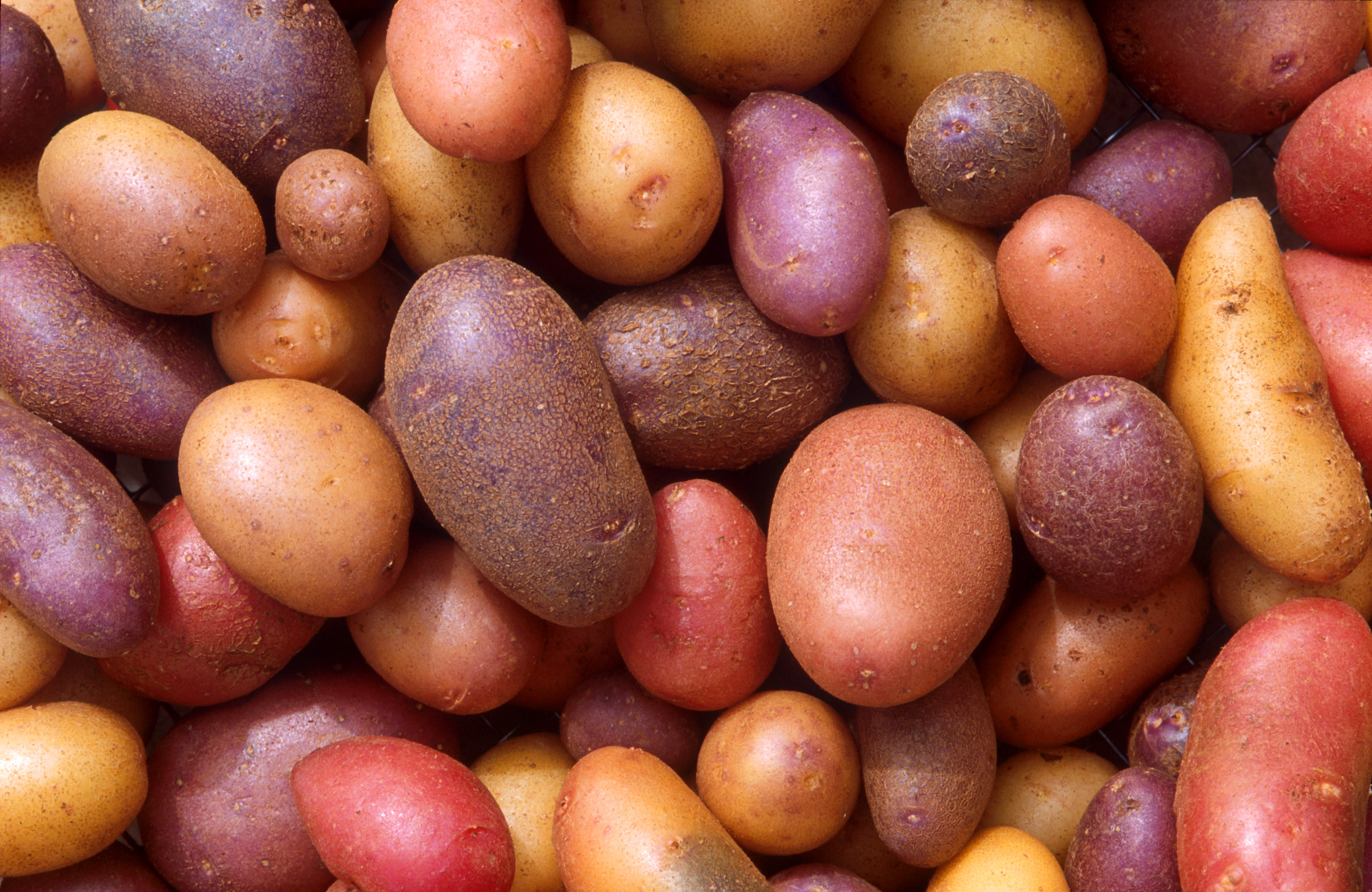
 Now let's talk about the potato.  Not only is it fun to say... but it's a very nutritious tuber.

Potatoes are in the same plant family as deadly nightshade (belladonna).  But don't worry too much, because so are Tomatoes and Eggplants.  This family also includes Mandrake, Paprika, Chili peppers, Tobacco and Petunias.

this image is in the public domain
Potatoes have vitamin C, Potassium, vitamin B6, as well as a good amount of fiber.  With it's skin on a potato has about the same amount of fiber as whole grain bread, cereal or pasta.

Most people worry about the starch/carbohydrate content of potatoes.  But some of the starch in potatoes is actually resistant to digestion in the stomach, and has similar beneficial effects to fiber.  The amount of this resistant starch is related to how the potato is prepared.  Potatoes that are cooked and then cooled (such as in potato salad) have more insoluble starch than hot potatoes (by nearly double).  Maybe next time we'll be making Potato Salad.

(citations: Food Network, Wikipedia, potato image, Recipe inspired by Suzanne Welsh)