Showing posts with label Cooking. Show all posts

Thursday, May 22, 2014

Steak, Potatoes and Spinach with Blue Cheese

So... it's been a while.

Let me see if I can catch you all up in just a few sentences...
I'm two years older.
I've had a baby. She's adorable and getting cuter every day.
I've done a lot of decluttering and reorganizing to streamline my life.

I think that about sums it up.

Now, on to the reason for the post.


Isn't that gorgeous.  I made up some of it, and while I was cooking I said to my husband, "if this turns out well, I'm totally going to make a lazy wife post about it."  And it turned out amazing.

***

Steaks with Red Wine butter - derived from Les Halles cookbook by Anthony Bourdain
The following measurements are not exact and should be tweaked to suit your own tastes.

1 small red onion (the original recipe calls for shallots)
1 cup red wine (I used Merlot, you can get inexpensive red wine but make sure its something you wouldn't mind drinking)
Salt
2 sticks of butter

Enough steak to feed your family
Salt & Pepper

To make the flavored butter:
Mince your onion, and put it in a pan, and a pinch or two of salt (depending on your tastes).  Add the wine and bring up to a simmer.  Stir occasionally until the wine has almost completely evaporated. Cool to room temperature. Soften the butter and blend the butter with the onion.  You can do this in a food processor, or a mixer, or by hand.  Just make sure it's fully incorporated and there's no large sections of plain butter.  Then get out some parchment paper or plastic wrap, and make a log out of the flavored butter and chill in the fridge.
You can also freeze the butter and use it at a later time - I have a bit in my freezer that I pull out any time I want some quick, easy, and delicious steak.

For the meat:
Salt and pepper one side of the steaks.  I like using top sirloin, but you can use whatever steak you like. Preheat your oven to 350.  Also, preheat an oven safe pan on the stove - I have a lovely cast iron skillet that works great.  Once the pan is hot, sear the seasoned side of the meat and season the other side with salt and pepper.  Sear all sides and then put the pan in the oven and cook until it's done to your liking.  My husband likes his steak well done, so I get everything else going before I turn the oven off and take the meat out to rest.  Once the meat is done, take it out of the oven and put a nice pat of butter on top and let the meat rest for 5 - 10 minutes so all the delicious juices get redistributed and the butter melts.  Mmmmmm, my mouth is watering just thinking about it.

Pan Fried Potatoes and Onions
I eat this for breakfast most days with a fried egg, but they're just as delicious for dinner.

3-4 medium sized Yukon Gold Potatoes (about 1 medium potato per person)
1 medium-large onion
1 Tbsp butter (you can use the wine butter in place of regular butter)
Dried Thyme (optional)
Salt

I use a 10" ceramic non-stick skillet for this recipe.  Preheat your pan on medium heat.  Chop your potatoes and onion into bite sized cubes (for breakfast, I like to slice them more thinly) Melt the butter in your preheated pan. Add the onion and potatoes, and sprinkle a pinch or two of salt and dried thyme.  Cover, stirring occasionally (or do that awesome chef-flick to flip everything) until the potatoes are soft.  Then remove the cover and still stirring occasionally, cook until it gets deliciously caramelized and browned - you may have to turn the heat down so it doesn't get blackened.

Creamed Spinach with Blue Cheese
I just made this up last night, so my recipe is very inexact.

1 bag frozen chopped spinach
1 tsp better than bullion chicken broth
1/2 tsp garlic powder (more or less depending on how much you like garlic)
1/4 cup milk
1/4 cup blue cheese crumbles

In a sauce pan on low/med-low heat, add frozen spinach, chicken broth, garlic powder - put the cover on until the spinach has thawed.  Once thawed, add milk and stir occasionally while it simmers for about 15 min.  Add the blue cheese and stir to melt it in.


Then you serve it all up and feel like you're eating at a 5 star restaurant.  I'm so glad I added that blue cheese to the spinach... and I'm also glad that I made enough last night that I have left overs to eat for lunch today :)

Tuesday, March 27, 2012

A Very Quick Update

Hello Friends!

It has been a while... but I've been working and working and working... since my Husband didn't have a job... Well, he had two jobs, but they were only part-time, so those kind of don't really count as a Job job.  But now he has a Job job... so we're happy.  The only problem now - we have to move (about 280 miles north of where we are now).

But this is good for us!  (I keep trying to tell myself that - over and over again)  And it's good for you because I'll actually have time to write about my cookery and crafty adventures!  (And maybe a few more comics for fun)  Yup that's right, in about three weeks time the Lazy Wife will be back :D

Also, I wanted to do a little shout out to the people that commented because they found my blog on Pinterest.  I wasn't even on Pinterest myself, but people pinned the Honey Bran Muffins I made, so that's awesome!  Thanks to everyone that pinned my muffins!  You make me feel loved :D

Friday, April 22, 2011

Candied Almonds

As I was wondering what to do with my left over evaporated milk, I found a recipe for Candied Pecans that sounded pretty good.  But then I realized that I didn't have any pecans sitting around, and I didn't particularly want to go out an buy any because I'll be moving soon, and the fewer things I have to take with me, the better.  I did have a large bag of almonds though.  So I decided to adapt the recipe to almonds, pecans would work well too, of course.  The original recipe is here.  But I ended up doubling it (but I'll post the original proportions, because really, how often do people need 6 cups of candied almonds?), so that I could use up all the evaporated milk I had, and I added a few more spices, because really 1/4 tsp of cinnamon is not enough.

***

Candied Almonds


3 Cups whole Almonds
1 cup sugar (1/2 brown sugar, 1/2 white)
1/4 cup Evaporated milk
2 Tbsp Water
1/2 tsp Vanilla
1 tsp Cinnamon
1/4 tsp Ginger
1/4 tsp Cardamom
1 pinch Clove
1 pinch Cayenne pepper (if you want a slightly spicy sweet nut)

Friday, April 15, 2011

Mini Pommes Anna

That's right! Potatoes! Not just any potatoes! Deliciously French potatoes, or rather Mini Pommes Anna.


Wikipedia tells us that "Pommes Anna is a classic French dish of sliced, layered potatoes cooked in a very large amount of melted butter."

I can't take full credit for this recipe, since I got the idea here: Bakers Royale

I changed the recipe a little, since I didn't have any Yukon Gold potatoes (those would be really good for this though) but I had a mixed bag of fingerling potatoes... and they were also very delicious.  And looked a little more like a real Pommes Anna instead of just a single stack of sliced potato.

***

Mini Pommes Anna

Wednesday, April 6, 2011

Asian Food Kick

I've been craving Asian food recently.  I don't know why... but I want everything with rice, soy sauce, and all those other "typically" Asian tastes and flavors.  I got a jump start on the week when my friend had us over for dinner and served Vietnamese spring rolls.

At least, I've always heard them called Vietnamese spring rolls, they are also known as fresh spring rolls, Vietnamese salad rolls, and sometimes summer rolls.  They look very pretty and are really not so difficult to make.  Ingredients vary based on what you want/like.  My friend made vegetarian rolls, using vegetables she had on hand.  I made mine with chicken.  They make a great meal and can either be pre-made, or you can have your guests make them for themselves.  It would be really fun to have a roll making party, and everyone can put in or leave out whatever they want.


My friend generously gave me the rest of the rice paper and rice vermicelli that she had left over, so I decided that tonight was Spring Roll night.  Really, the only mandatory ingredient is the rice paper, everything else is up to your taste and what you want to put in, quantities are also flexible for whatever size group you have.


Monday, February 7, 2011

Crabapple Jelly

It's a Crab - Apple... get it?
I have been particularly lazy of late.  I don't have any good excuses for my laziness, so I won't give any.  But I did draw a silly picture for you all... Well, I drew the apple part... the limbs were taken off another picture (when I realized that I couldn't remember what crab legs looked like).

Today, I will relate the events that occurred a few months ago when the trees were bearing fruit, and I happened to be listening to quite a bit of British literature, such as P.G. Wodehouse's Jeeves and Wooster and Jane Austen Novels adapted for radio.  Within those stories, I heard how frugal people would pick fruit from the trees and preserve it for the winter months when fresh fruit was hard to find.  While considering this, I was walking to pick up the mail from our box at our apartment and I began to wonder what kind of fruit trees were in our complex.

I picked one of the globular pinkish fruits and a couple leaves and took them back to my apartment.  I searched on the internet to find a description that matched the fruit I had found.

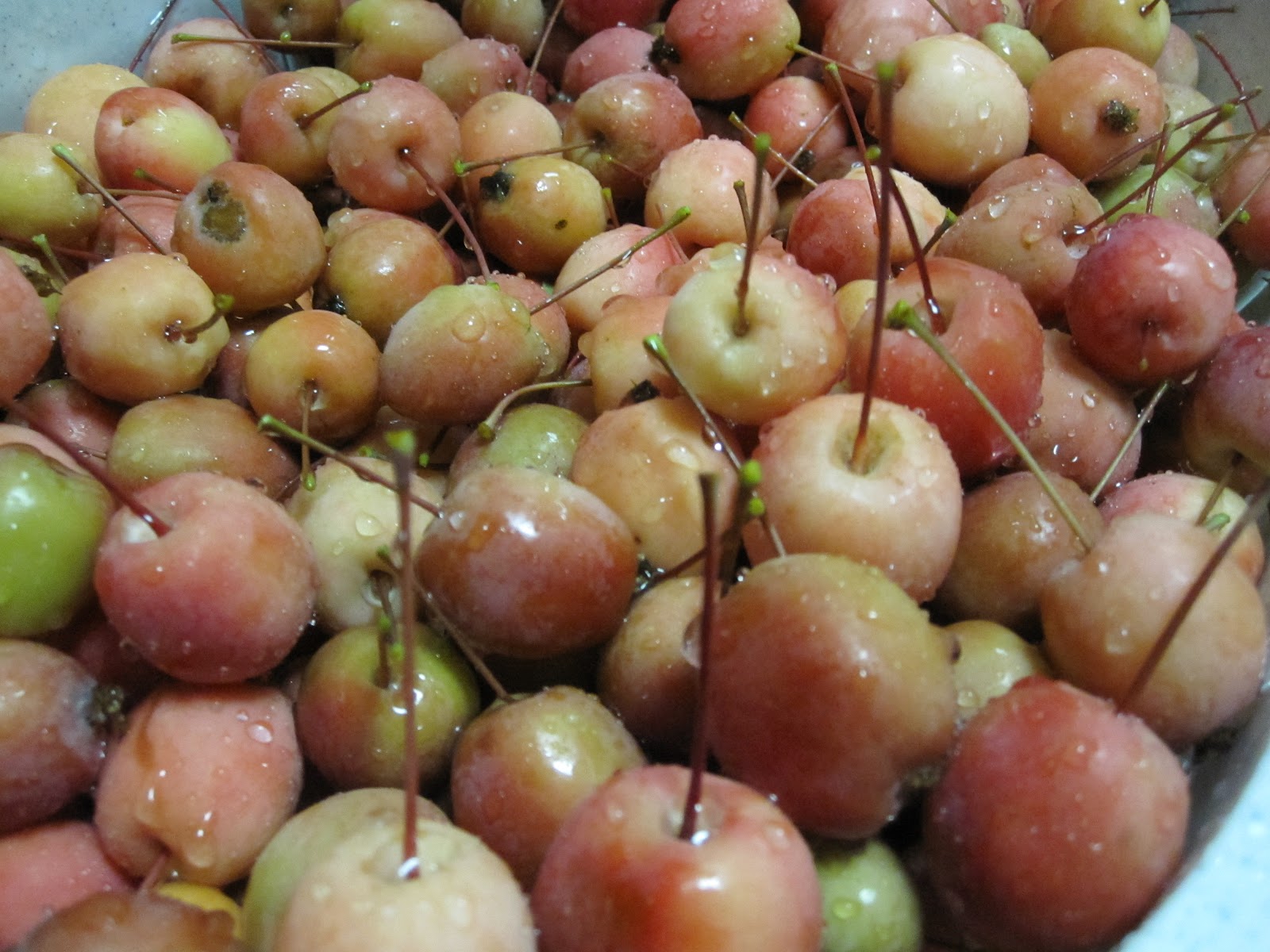
I discovered that apples are the only fruit with seeds in a star pattern.  They are related to roses and also have serrated leaves.  I compared my samples with the descriptions and discovered that I had several crab apple trees in perfect readiness for harvest.  Crab apples do have an apple-like taste and smell, but are generally a more tart.

So I harvested them.  I made Husband go out with me and hold a bag while I pulled the small apples off the higher branches (using a step ladder, of course).  I brought them home, and washed them thoroughly.  Once they were well washed, I cut them up and boiled them in water.  I squeezed them through a cheesecloth and then used that juice to make crab apple jelly.

The first try I got it into my head that I might not have to use pectin, because after doing a little reading, pectin apparently comes from apples, and other relatives.  However, I must have done something wrong (or my apples just didn't have enough pectin) because the jelly didn't set.  So I boiled it all over again, added pectin this time, and got a quite nice jelly in my re-sterilized jars.


Here's the recipe:

***

Crab Apple Jelly

Crab Apples (about 8 cups?)
Water
1 box Pectin
3 cups sugar

If starting with whole fruit:
Remove stems and leaves.  Cut crab apples in half (or quarters if you have large crab apples) and put them in a large pot.  Pour in enough water to almost cover the apples, but not to make them float.

Bring to a boil and then turn down to medium.  Let cook until the apples change color and are soft.  (You can also use a juicer, if you have one)  Let it cool, then strain the apple mash through a few layers of cheesecloth... you may need to squeeze the juice out.

Measure about 4 cups of juice and put in a pot with 1 box of pectin.  Bring to a boil, then add 3 cups of sugar.  Bring back to a boil and boil for at least 1 minute.

Pour into sterilized jars, leaving 1/4" space at the top.  Put on lids and process in boiling water for 5 minutes.  Remove jars from water bath and let cool, being sure the lids seal and the jelly has set.  Keep in a cool dark place, and these should last for at least a year.

Enjoy!

***

That's it for the recipe.  I must admit that every time I hear "Crab Apples" I think of some sort of strange crab with the body of an apple... then I stumbled across this picture:

and I'm glad that my imagination lines up so well with other people's.

Monday, January 17, 2011

Chicken Pot Pie

The other day I went ahead and bought a 25lbs bag of flour at Costco. I also bought some boneless skinless chicken thighs. I had been buying chicken breasts, but the thighs were so much less expensive... and then I cooked with them and discovered how much more flavor the thighs had, I'm very pleased that I bought them.

It's cold and damp where I am right now, and it felt about the right time for some good old fashioned comfort food.

I've never made Chicken Pot Pie before, and so I set out to make one. I started with the 1896 Boston Cooking-School Cookbook, the plain paste recipe, to be specific.  Then I just sort of thought about what is normally in chicken pot pie and went from there.

***

The Lazy Wife's Chicken Pot Pie

Pie Crust:
1 1/2 cup flour
1/2 cup butter, cut in cubes
2 Tbsp vodka
2 Tbsp cold water

My crust ended up being a little thin, but very flaky and delicious, next time I'd probably double the pastry recipe, then again, I did end up making two pies. 

Put flour in a medium bowl and cut in the butter cubes.  Add vodka and water until you can form a smooth ball (sometimes it requires a little more vodka or water if your flour is dry).  Place the smooth ball in plastic wrap and chill for about 15min.  Preheat the oven to 350 degrees, roll out the chilled dough on a lightly floured surface, and place in pie pan.  Cover with wax paper and pie weights (I use beans).  Prebake for about 10 min with the weights, then remove them and bake another 5-10min until it just starts to get a light brown color.  Remove from oven and fill with chicken filling.
 
Pie filling:
1-2 Tbsp olive oil
1 onion, chopped
8-10 cloves garlic, minced
3 boneless skinless chicken thighs, cubed
1/2 cup frozen corn
1/2 cup frozen peas
1/2 cup mixed vegetables (I like the "hodgepodge"  mix from Trader Joes)
1 carrot, chopped
1 can condensed potato soup
1 Tbsp Herbed Poultry (from my spice rack, I think it's Sage, Rosemary, Thyme and Marjoram)
1 tsp Worcestershire sauce
1 Tbsp flour
1 Tbsp butter
Salt & Pepper
In a medium pot, saute the onion and garlic in olive oil, on low heat, until soft.  Add herbs, salt and pepper (about 1 tsp of each), add chicken and continue cooking, turn up to medium heat, stirring occasionally.  When the chicken is cooked, add vegetables and soup (as well as 1 can of water).  Stir until all ingredients are combined.  Add flour and butter and stir until incorporated.  Cook down to thicken.

When the pie crusts are ready (prebaked/just starting to brown, you can use scraps of pie crust to put on top for a cute decoration, bake them with the crusts but on a separate baking sheet) add the chicken filling to the pie shells and bake at 350 for 20min until the crusts are brown and the filling is bubbling.

Take out of oven and serve.

***

Well, that's about it for the recipe.  It tastes pretty darn awesome (the Husband even went back for seconds, despite the pie containing peas).  Chicken breast would obviously work as well, but I really do think the thighs have better flavor.

Also, I'm working on a pair of socks now... but I'll post about those later, when I have pictures and such.  That's all for now!

Saturday, January 8, 2011

Hummus

My husband was recently bothering me because I had not made hummus last semester.  So, by request, I made hummus today.

Hummus is a Middle Eastern staple food.  When eaten with bread it makes a complete protein, which is awesome especially if you're vegetarian or vegan (though understandably less awesome if you suffer from Celiac disease).  Hummus is actually pretty easy to make.  It relies heavily on taste... so be sure you're tasting as you go.  So, here's my recipe, feel free to play with it and adjust as you like.

***


Hummus, ala the Lazy Wife

1 lb bag dried chickpeas (you can, of course, use canned chickpeas, dried are sometimes cheaper)
Water
1 head of Garlic, minced
The juice of 2 Lemons
1/3 - 1/2 cup Tahini (Sesame seed paste)
1/2 cup Olive Oil
Salt to taste
Optional Hand full of Sun Dried Tomato, Red Pepper, Paprika, Basil, Avocado, Chipotle pepper, etc.

For the Hummus purists (No optional extras):
Soak the dry chickpeas in water overnight.  Drain the old water and cover the now plumped peas with water by about an inch over the level of the peas... it's not important to get the water quantity exact for these steps, just to make sure the peas absorb as much water as they need to become soft.  Bring the peas to a boil, cover and reduce heat to simmer.

My chickpeas have always boil over... but uncovered they smell funny, so choose your poison.
Lower: cooked peas, top left: pea skins, top right: naked peas

Once the chickpeas are soft (30min - 2 hours). It really depends on how much attention I'm paying... when they're soft to the touch (squish one between your fingers after letting it cool and see if it mashes easily) turn off the heat and let them cool.

Hummus with Sun Dried Tomato and dried red pepper
Hummus with olive oil and paprika
When you can handle them, strain the chickpeas and prepare for the "fun" part.  Now, some people just leave them in water and roll them around in their fingers to remove the skins, because the skins, for the most part, rise to the top and can be skimmed off.  I, however, am a perfectionist.  I sit down and watch something while I squeeze the skin off of each and every pea.  My other reason for this is because I do not own a food processor, and mash the peas with a potato masher, and I get a better consistency when I remove every skin.  If you don't care about texture or are blessed with a food processor, then go ahead and remove as much of the skins in whatever way you like.

After removing all the skins, put the peas in a medium to large size bowl.  Add the garlic, lemon juice, tahini, olive oil and some salt, and mash until you get a nice smooth paste.

Some of the ingredient amounts can vary depending on how moist or dry your chickpeas are, and how much you like or dislike certain flavors.  I happen to LOVE garlic, so I used a whole head... just enough to almost give me heartburn.  If you don't like garlic so much, then use 1-5 cloves or whatever you like.

If you find the mashing is not giving you a nice smooth paste, then add a little more tahini, olive oil or lemon juice, depending also on what flavor you think is lacking.  You do have to play with it a little, to get the right taste for your pallet.

If you're feeling a little more adventurous,  you can experiment a little more.

Make the original recipe, but at the end stir in some chopped up sun dried tomato, or some red pepper, or avocado... I know at the farmer's market I used to go to, there was a guy that had all kinds of interesting flavors of hummus.

In most of the Middle Eastern restaurants I've been to, they serve hummus with olive oil and paprika on it.

If you can't find tahini (which I couldn't for a while where I am) I substituted smooth peanut butter!  I know!  Sounds totally crazy, right?!  Well, I did, but I used a little less peanut butter and a little more olive oil and lemon juice, and lots of garlic.  Once it sat for a day in the refrigerator, it tasted pretty much the same as regular hummus, with maybe a little more of a nutty aftertaste.

***

The historical origins of Hummus are unknown.  The earliest verified description of hummus comes from 18th century Damascus.  There were probably similar recipes before the 18th century, and in fact, the Egyptians ate a similar dish that used vinegar instead of lemon juice (which was the ingredient that arrived in the middle east later than all the others).  But it is still unknown where or when hummus, as we know it today, was first made.

Chickpeas are GREAT! Chickpeas are a good source of zinc, folate, and protein.  They have a lot of dietary fiber and are a good source of carbohydrates (especially for people that are insulin sensitive/diabetics).  They also contain phosphorus, magnesium and iron.

Citations: Wikipedia: Hummus, Chickpea

Friday, December 3, 2010

Beans are amazing.

Yup, that's right.  Beans are amazing.  Sometimes I forget just how amazing beans are.

Beans are one of the longest-cultivated plants.  The cultivation of beans even predates ceramics!  Beans were an important source of protein throughout Old and New World history, and still are today. There are over 4,000 cultivated varieties of bean on record in the United States alone.  Certain beans, like Kidney beans are actually toxic, but don't worry because boiling them for at least 10 minutes destroys those toxins.  Another method of destroying the toxins (and making the beans more digestible for humans) is to ferment them.

Today, let's focus on fava beans (also known as: Broad Beans, Bell Beans, Tic Beans, Butter Beans, Windsor Beans, Horse Beans, English Beans, Feve Beans, Faba Beans, Haba or Habas)  These are not to be confused with Lima beans which are sometimes also called butter beans.
  • In ancient Greece and Rome, beans were used in voting; a white bean being used to cast a yes vote, and a black bean for no.  Also, beans were used as a food for the dead, especially during festivals. 
  • In Italy, broad beans are traditionally sown on November 2, All Souls Day. Small cakes made in the shape of broad beans (though not out of them) are known as fave dei morti or "beans of the dead". According to tradition, Sicily once experienced a failure of all crops other than the beans; the beans kept the population from starvation. Some people carry a broad bean for good luck; some believe that if one carries a broad bean, one will never be without the essentials of life. 
  • In Portugal, a Christmas cake called Bolo Rei ("King cake") is baked with a fava bean inside. Whoever eats the slice containing it, is supposed to buy next year's cake.
  • European folklore also claims that planting beans on Good Friday or during the night brings good luck.
Broad beans are rich in tyramine, and should be avoided by those taking monoamine oxidase inhibitors (MAOIs).  Raw broad beans contain the alkaloids vicine, isouramil and convicine, which can induce hemolytic anemia in people with a glucose-6-phosphate dehydrogenase deficiency and can be fatal (also known as "favism").  Though, hemolysis resulting from "favism" may actually act as a protection against malaria.  Broad beans are also rich in L-dopa.  This substance is used medically in the treatment of Parkinson's disease.  It is also a natriuretic agent, which might help in controlling hypertension. 
According to the National Nutrient Database for Standard Reference, one cup of cooked fava beans contains about 187 calories, 1 g of fat, 33 g of carbohydrates and 13 g of protein.  73% of calories come from carbohydrates, 3% from fat and 24% from protein.  They have 9 g of fiber (37% of the daily value).  Fava beans are a rich source of many essential vitamins, especially B vitamins.  Fava beans also contain many essential minerals. They are a good source of manganese, copper, phosphorus, magnesium, potassium and iron.  While fava beans are a good source of protein, the protein they contain is not complete and must be paired with complementary proteins, such as those contained in grain products. 
Alright, I'm sure that's enough information for all of you to realize that beans are really awesome.  Now, on to the recipe.

Citations: Wikipedia: Bean, Vicia faba, Cook's Thesaurus: Dry Beans)

A little background:
A bit over a year ago, I went to Scotland with Opal, her mom, and Rita.  Opal's mom has a jewelry company called Billy's a Bad Kitty, and they had a booth at a Scottish art fair during the Fringe Festival.  There was a little restaurant/cafe next to the art fair.  It carried some pies that we would sometimes eat for lunch.  One of those pies was "Butter bean and Brie Pie."  It was possibly the most wonderful taste experience of my life.  Imagine yourself in an extremely old Scottish cemetery.  It's drizzling rain.  You're a bit cold, wrapped up in warm clothes, and you go into the warm restaurant and buy a single serving pie with a beautifully golden puff pastry shell.  You take it back to the booth.  You cut into the pie with your fork and take a bite.  It's magical.  Buttery crust, perfectly cooked beans, flavorful but not overbearing brie, and a slightly creamy sauce  to tie it all together.

I'm drooling just thinking about it.

Well, I came home and dreamt about that pie.  I was still going through me "I don't like baking" stage, so I let it sit there in the back of my mind... waiting for the right moment to strike.

Life happened, I was home for Thanksgiving, and among the things I was sent back to Davis with (Thank you, Mom), was a 12 oz  bag of dry fava beans.  I couldn't figure out what I was going to do with them until I looked them up online, and found out that they're also called butter beans.  And then the pie sprang into my thoughts.  I went and bought a wedge of brie and some frozen puff pastry (yes, I could have made croissant dough... but I was feeling lazy).  I had all the other ingredients at home.  And so it began.

***

This is the description from Simple Simon's website:
butter beans are casseroled in a vegetable and white wine stock with a good dose of garlic and finished with parsley, cream and lemon juice. Brie is then added to the cooled ingredients prior to baking.

This is what I ended up with (measurements are approximate):

1lb Butter Beans (if you're starting with dried fava beans you'll have to soak them overnight, then blanch them in boiling water for 10min, then cool them and take off the outer shell/thick husk before you boil them with the other ingredients)
2 cups Vegetable stock (chicken broth also works)
3 dashes White wine (I had sherry, and I wasn't going to go buy a bottle of wine just for 1 recipe)
5 cloves Garlic, minced
1/4 large onion, chopped and sauted
1 tsp Parsley
1/4 cup Cream (or 1/2&1/2)
1 Tbsp Lemon Juice
1 largish wedge of Brie cut into chunks


Cook beans in broth, wine and garlic until tender.  Stir in sauteed onion, parsley, cream and lemon juice into Butter bean mixture, let cool.

Preheat oven to 400.  Place puff pastry into a muffin pan (I wanted to make small pies) and spoon mixture in puff pastry shells, cover with more pastry, making sure the pies are sealed around the edges (use water or egg, according to puff pastry directions), bake about 10-15min until golden brown.  (For my pies, I ended up taking the pies out of the muffin pan and flipped them over onto a baking sheet and baked them another 5-10min so the bottoms were also browned and puffy).

***

I know it's cheating, but I really would recommend the Trader Joe's Frozen Puff Pastry... they worked very nicely.  The Husband even commented on how much he liked the pastry shells.

I know I'm going to end up making these again, because they are SO delicious.  Probably for a party this Christmas season.

The Husband is working on getting his finals done for school, so who knows when I'll post next, but I am hoping that I'll have more things to post over the winter break.  For now, I'll leave you with this:

Sunday, November 14, 2010

Marinara Sauce

Cooks aboard Napolitan ships invented marinara sauce in the mid-16th century after Spaniards introduced the tomato (a New World vegetable) to Europe. This meat-free sauce was easy to make and resisted spoiling due to the high acid content of tomatoes. This made it ideal for lengthy sea voyages hundreds of years before refrigeration methods were invented. (Wikipedia: Marinara Sauce)

Everyone has their own recipe for Marinara or Spaghetti Sauce.  I picked up a few ideas from my mom's recipe, and my husband's mom's recipe.  I added some touches of my own, and am happy to now share it with all of you.

***

Ground Turkey Marinara Sauce (in a crock pot)

1 Onion, Chopped
10 cloves garlic, minced (more or less depending on how you feel about garlic)
2-3 Tbsp olive oil
1 package Lean Ground Turkey (1.25 lbs)
1 Red bell pepper, chopped
3-4 Tbsp dried basil
1 Tbsp dried parsley
2 tsp dried oregano
1 tsp fennel seed
3 large cans of crushed tomatos
1 small can tomato paste (if the sauce is not thick enough)
salt and pepper to taste

To a crock pot on high heat add onion, garlic, and olive oil.  Sweat the onions (I usually add a little salt to them) stirring occasionally.  Add the ground turkey, stir to break into small pieces.  Add bell pepper, basil, parsley, oregano, fennel, and pepper.

Cook, stirring occasionally, until the meat is cooked.
Add the crushed tomatoes, stir and cook on low, stirring occasionally.

Cook down for several hours to get a thicker consistency, or add tomato paste if the sauce is too watery.  Taste, add salt and pepper if needed.  Serve on pasta or use in lasagna or anything else that uses marinara.

This sauce can be made vegan by just removing the ground turkey from the recipe.

***

Tomatoes were originally found only in the New World (South America), but now are eaten freely throughout the world.  Their consumption is believed to benefit the heart among other organs.  They contain lycopene, which is a powerful antioxidant.  Preliminary research has shown an inverse correlation between consumption of tomatoes and cancer risk, lycopene has been considered a potential agent for prevention of some types of cancers, particularly prostate cancer. Lycopene has also been shown to improve the skin's ability to protect against harmful UV rays. Tomato consumption has also been associated with decreased risk of breast cancer, head and neck cancers, and might be strongly protective against neurodegenerative diseases (like Parkinson’s, Alzheimer’s, and Huntington’s Diseases).
Some tomato varieties are available with double the normal vitamin C, 40 times normal vitamin A, high levels of anthocyanin (resulting in blue tomatoes), and 2 to 4 times the normal amount of lycopene. (Wikipedia: Tomato, Lycopene)

Wednesday, November 10, 2010

Preparations of Duck throughout the years

A friend requested that I find any old recipes I had for duck, so let's talk about duck.

Wild ducks have been hunted for food, down, and feathers worldwide since prehistoric times.  In America during the 1800's, there became a thriving commercial waterfowl hunting industry because of the need for food and the vast supply of birds.  Currently, most ducks used for consumption are farm raised rather than wild.

Ducks have been farmed for thousands of years; most likely farming started in Southeast Asia. They are farmed for their meat, eggs, and down. A minority of ducks are also kept for foie gras production. Their eggs are blue-green to white depending on the breed.

Ducks are more expensive and less popular than chickens because they have less lean white meat and are more difficult to keep confined than chickens are. Duck appears less frequently in the mass market food industry and lower priced restaurants and stores because of it's higher price tag.  Duck is generally only popular in "haute cuisine." 

(citations: Wikipedia: Duck, Mallard, Domestic Duck)

I will now include the recipes I have found for Duck, plus a traditional meal plan and those other recipes as well.  At some point, I'm going to give some really awesome traditional dinner parties, so I can use all of these delicious sounding recipes, and post about them as well.

Seven Centuries of English Cooking: A Collection of RecipesIf you are at all interested in what cooking was like during and before the 1920's, you should check out  Seven Centuries of English Cooking: A Collection of Recipes by Maxime de la Falaise.  It's awesome, and has all kinds of interesting historical foods! 

***
A Mallard, Smothered; from Seven Centuries of English Cooking, Gervase Markham, 1660:
A 3 pound Mallard or wild duck
2 Tbsp flour
2 Tbsp oil
1/2 cup chopped onion
1 cup stock
1 cup white wine
1/2 cup chopped mixed herbs
1/2 cup currants
1/2 cup chopped dates
2 Tbsp butter
2 Tbsp sugar
1 tsp powdered cinnamon
2 Tbsp wine vinegar or 1/2 cup gooseberries (or cranberries)
2 slices of toast, cut in sippets (A small piece of toast or bread soaked in gravy or other liquid or used as a garnish).

Dust the duck with flour and brown it in oil; brown the onions in the same oil. Braise the duck in the same pan and add the stock, wine and herbs. Simmer for about 1 hour; then add the currants and dates and simmer for another 30min or until the duck is tender.  Remove the bird and keep it warm.  Add the butter, sugar, cinnamon, wine vinegar or gooseberries, reduce the sauce and pour over the bird in a dish garnished with sippets.
***
Duck with Horseradish; from Seven Centuries of English Cooking, Charles Carter, 1732:
A 4-4 1/2 pound duck
2 Tbsp flour
2 Tbsp butter
2 1/2 cups chicken stock
1 cup grated Horseradish.
Garnish:
Freshly grated Horseradish
1 sliced lemon

Dust the duck with flour and brown it in the butter on all sides. Add the chicken stock and grated horseradish and simmer gently until the duck is tender.  Remove the duck and carve it.  Arrange the pieces on a warm serving dish, then skim the fat from the surface of the sauce and pour the sauce over the bird. Arrange the fresh horseradish at each end of the dish and the sliced lemon around the edges.

***
To Stuff and roast a Turkey, or Fowl; from The First American Cookbook, 1796:
One pound soft wheat bread
3 ounces beef suet
3 eggs
a little sweet thyme
sweet marjoram
pepper and salt
and some add a gill (1/2 cup) wine

fill the bird therewith and sew up, hang down to a steady solid fire, basting frequently with salt and water, and roast until a steam emits from the breast, put one third of a pound of butter into the gravy, dust flour over the bird and baste with the gravy; serve up with boiled onions and cranberry-sauce, mangoes (a name sometimes given to the cantaloupe; and often attributed to any vegetable or fruit: melon, squash, green pepper, etc. that can be stuffed and pickled), pickles or celery.
2. Others omit the sweet herbs, and add parsley done with potatoes.
3. Boil and mash 3 pints potatoes, wet them with butter, add sweet herbs, pepper, salt, fill and roast as above.
 ***
To Stuff and Roast a Goslin; from The First American Cookbook, 1796:
Boil the inwards tender, chop them fine, put double quantity of grated bread, 4 ounces butter, pepper and salt, (sweet herbs if you like; sweet thyme, marjoram) 2 eggs moulded into the stuffing, parboil 4 onions and chop them into the stuffing, add wine, and roast the bird.  This is a good stuffing for every kind of Water Fowl, which requires onion sauce (or gravy cooked with onions).

***
1896 Boston Cooking-School CookbookThis one is also a great guide to historical (and modern) cooking.  It has everything!

Roast Duck Dinner Menu; from The 1896 Boston Cooking-School Cook Book:
Cream of Lima Bean Soup
Roast Duck
Mashed Sweet Potatoes
Cauliflower au Gratin
Rice Croquettes with Currant Jelly
Grapes, Pears, Crackers, Cheese, and Cafe Noir.

Cream of Lima Bean Soup
1 cup dried lima beans
3 pints cold water
2 slices onion
4 slices carrot
1 cup cream or milk
4 Tbsp butter
2 Tbsp flour
1 tsp salt
1/2 tsp pepper

Soak the beans overnight; in the morning drain and add cold water; cook until soft, and rub through a sieve. Cut vegetables in small cubes, and cook five minutes in half the butter; remove vegetables, add flour, salt, and pepper, and stir into boiling soup.  Add cream, reheat, strain, and add remaining butter in small pieces.

Roast Duck
Dress and clean a wild duck and truss. Place on rack in dripping-pan, sprinkle with salt and pepper, and cover breast with two very thin slices fat salt pork. Bake twenty to thirty minutes in a very hot oven, basting every five minutes with fat in pan; cut string and remove string and skewers.
Serve with Orange or Olive Sauce. Currant jelly should accompany a duck course. Domestic ducks should always be well cooked, requiring little more than twice the time allowed for wild ducks.
Ducks are sometimes stuffed with apples, pared, cored, and cut in quarters, or three small onions may be put in the body of duck to improve flavor.  Neither apples nor onions are to be served.

Olive Sauce: Remove stones from 10 olives, leaving meat in one piece. Cover with boiling water and cook five minutes.  Drain olives, add 2 cups Brown Sauce*.

Orange Sauce:
1/4 cup butter
1/4 cup flour
1 1/3 cups Brown Stock*
1/2 tsp salt
Juice from 2 Oranges
2 Tbsp sherry wine
Rind of 1 orange cut in fancy shapes
dash of cayenne

Brown the butter, add flour, with salt and cayenne, and stir until well browned. Add stock gradually, and just before serving, orange juice, sherry, and pieces of rind.

*Brown Sauce: 2 Tbsp butter, 1/2 slice onion, 2 1/2 Tbsp flour, 1 cup Brown Stock, 1/4 tsp salt, 1/8 tsp pepper.  Cook onion in butter until slightly browned; remove onion and stir butter constantly until well browned; add flour mixed with seasonings, and brown the butter and flour then add stock gradually.

*Brown Stock: marrow bones, beef, poultry carcasses, carrots, turnips, leeks, celery, parsnips and onion. Simmered and skimmed for several hours producing a dark brown liquid.

Mashed Sweet Potatoes
To 2 cups boiled & riced or mashed sweet potatoes add three Tbsp butter, 1/2 tsp salt, and hot milk to moisten. Beat until light, and pile on a vegetable dish.

Cauliflower au Gratin
Place whole cooked cauliflower (or cut for easier serving) on a dish for serving, cover with buttered crumbs, and place on oven grate to brown crumbs; remove from oven and pour one cup Thin White Sauce around cauliflower.
Thin White Sauce:
2 Tbsp butter
1 cup scalded milk
1 1/2 Tbsp flour
1/4 tsp salt
dash of pepper
Melt butter in saucepan, add flour mixed with seasonings, stir until thoroughly blended. Gradually pour in milk, stirring until well mixed, then beating until smooth and glossy.

Rice Croquettes with Currant Jelly
1/2 cup rice
1/2 cup boiling water
1 cup scalded milk
1/2 tsp salt
2 egg yolks
1 Tbsp butter

Wash rice, add to water with salt, cover and steam until rice has absorbed all the water. Then add milk, stir lightly with a fork, cover and steam until rice is soft. Remove from heat, add egg yolks and butter; spread on shallow plate to cool. Shape into balls, roll in breadcrumbs, then shape in form of nests. Dip in egg, again in crumbs, deep fry until golden and drain. Put a cube of currant jelly in each croquette. Garnish with parsley.

***
Sounds good, doesn't it?  I may have to go out and get myself a duck to try at least one of these preparations. In the mean time, I think I'm going to have to try those Rice Croquettes, and probably the cauliflower au gratin.  I'll let you know how they turn out!

(If you have any questions, suggestions or recommendations for recipes... Please feel free to comment on any posts, or send me an email: thelazywife@gmail.com)

Wednesday, September 22, 2010

Vegetable Soup

Do you have vegetables slowly wilting in your refrigerator?  Don't know what to do with those chicken bones left over from your Friday night dinner extravaganza?  Well, it's time to make some delicious Vegetable Soup!

We had friends over Friday night last week, and it being the first time we'd seen them since the beginning of summer, I decided to roast a chicken.  I thought about killing a fatted calf, but I didn't happen to have one on hand.

The roasted chicken (with sliced vegetables) was a little on the bland side, but once we had finished picking the meat off the bones, I through all the rest of it (bones, skin, and all) into a pot and covered them with water and added some "Poultry Seasoning" from my spice rack.  After simmering for most of a day , I decided that it was done, and strained the broth.  It sat in the fridge for 2 days.  I skimmed off the fat that solidified on the surface.  I left some smaller pieces because we all know that's where the flavor comes from.

Thus I had created: Chicken Stock. 

Now you may be wondering (like I was just a moment ago): What is the difference between Chicken Stock and Chicken Broth?  Aren't they the same thing?

The answer is no.  Chicken Stock is made from the bones and stuff you wouldn't normally eat on the chicken.  Chicken Broth is usually made from the meat.  Stock tends to have a richer flavor because some of the gelatin is released by cooking the bones.  (Thanks, Food Network). For more go here: Wikipedia.

But enough about chicken.  We're making Vegetable soup today!

***

Vegetable Soup
Recipe by The Lazy Wife

1/2 Onion, chopped - I used red, but you could use any kind
1 TBsp Olive oil
4-5 Cloves Garlic, minced
2 medium Potatoes, small cubes - I left the skin on and made the cubes small, potato skin is good for you!
2 stalks Celery, chopped
4 cups Chicken Stock - Chicken broth should work, or make it vegan/vegetarian friendly and use vegetable broth
1/4 cup Sherry
1 large Leek, cut lengthwise and then in strips
2 Mushrooms, diced
10 baby carrots, diced
1 red bell pepper, diced
1/2 cup frozen corn
1/2 cup frozen peas
1-2 cups water
1 Bay Leaf
Salt and Pepper to taste
You know you love the pretty colors!

Wash and cut up your vegetables.  Sauté the onions in a pot with the olive oil and some salt and pepper, add the garlic after the onion is soft.  Then toss in the potatoes, celery, chicken stock and sherry (you could leave this out, but I like the flavor it gives) add water at any point if the broth does not cover the vegetables enough.  After the potatoes are soft (about 15min) use a potato masher to break the potatoes into smaller pieces and give the broth more texture.

Then add the bay leaf, leek, mushrooms, carrots, bell pepper, peas and corn (as I said, empty your refrigerator... you could use whatever vegetables you want in this).

Simmer until the vegetables are soft and serve with some toast or croutons.  You could even put a little bacon on top, or add ham, chicken, rice or barley to it.  It would be very delicious with barley.

***

 Now let's talk about the potato.  Not only is it fun to say... but it's a very nutritious tuber.

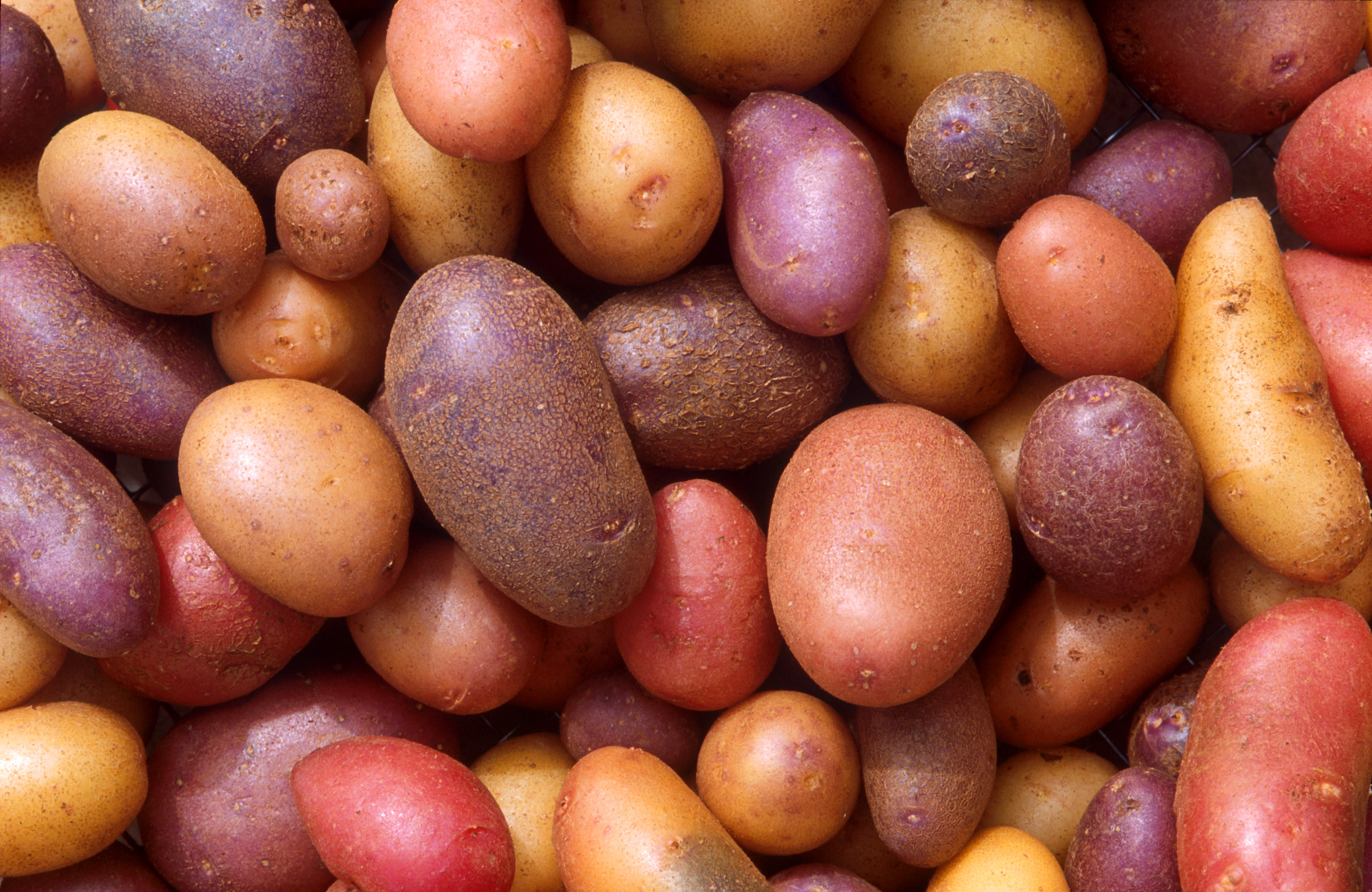
Potatoes are in the same plant family as deadly nightshade (belladonna).  But don't worry too much, because so are Tomatoes and Eggplants.  This family also includes Mandrake, Paprika, Chili peppers, Tobacco and Petunias.

this image is in the public domain
Potatoes have vitamin C, Potassium, vitamin B6, as well as a good amount of fiber.  With it's skin on a potato has about the same amount of fiber as whole grain bread, cereal or pasta.

Most people worry about the starch/carbohydrate content of potatoes.  But some of the starch in potatoes is actually resistant to digestion in the stomach, and has similar beneficial effects to fiber.  The amount of this resistant starch is related to how the potato is prepared.  Potatoes that are cooked and then cooled (such as in potato salad) have more insoluble starch than hot potatoes (by nearly double).  Maybe next time we'll be making Potato Salad.

(citations: Food Network, Wikipedia, potato image, Recipe inspired by Suzanne Welsh)