Showing posts with label Jeeves and Wooster. Show all posts

Friday, March 25, 2011

What I did this week...

 At first I thought I was just being extremely lazy... then I thought I was suffering from something even worse and much more sinister than laziness...

I've also been mixing some delicious cocktails inspired by watching Jeeves and Wooster... but it's not a good idea to add rum to your sloth... you end up with a drunk sloth... which, if I could draw, would be a very funny picture indeed.  I'm not sure why I feel slothful though, because I have So Many Projects.  Here, just to show a few:

Not sure what the flowers will be for, but they're cute :D
I had to use up the Baileys frosting :)
Bacon, Cheddar and Broccoli quiche
The cake was just boxed yellow cake with chocolate chips, but I had to have something to put the Baileys frosting on... Here 's the quiche recipe for those of you that might like to try it (really the filling could contain any number of delicious things, I just picked three things I liked:

Monday, February 7, 2011

Crabapple Jelly

It's a Crab - Apple... get it?
I have been particularly lazy of late.  I don't have any good excuses for my laziness, so I won't give any.  But I did draw a silly picture for you all... Well, I drew the apple part... the limbs were taken off another picture (when I realized that I couldn't remember what crab legs looked like).

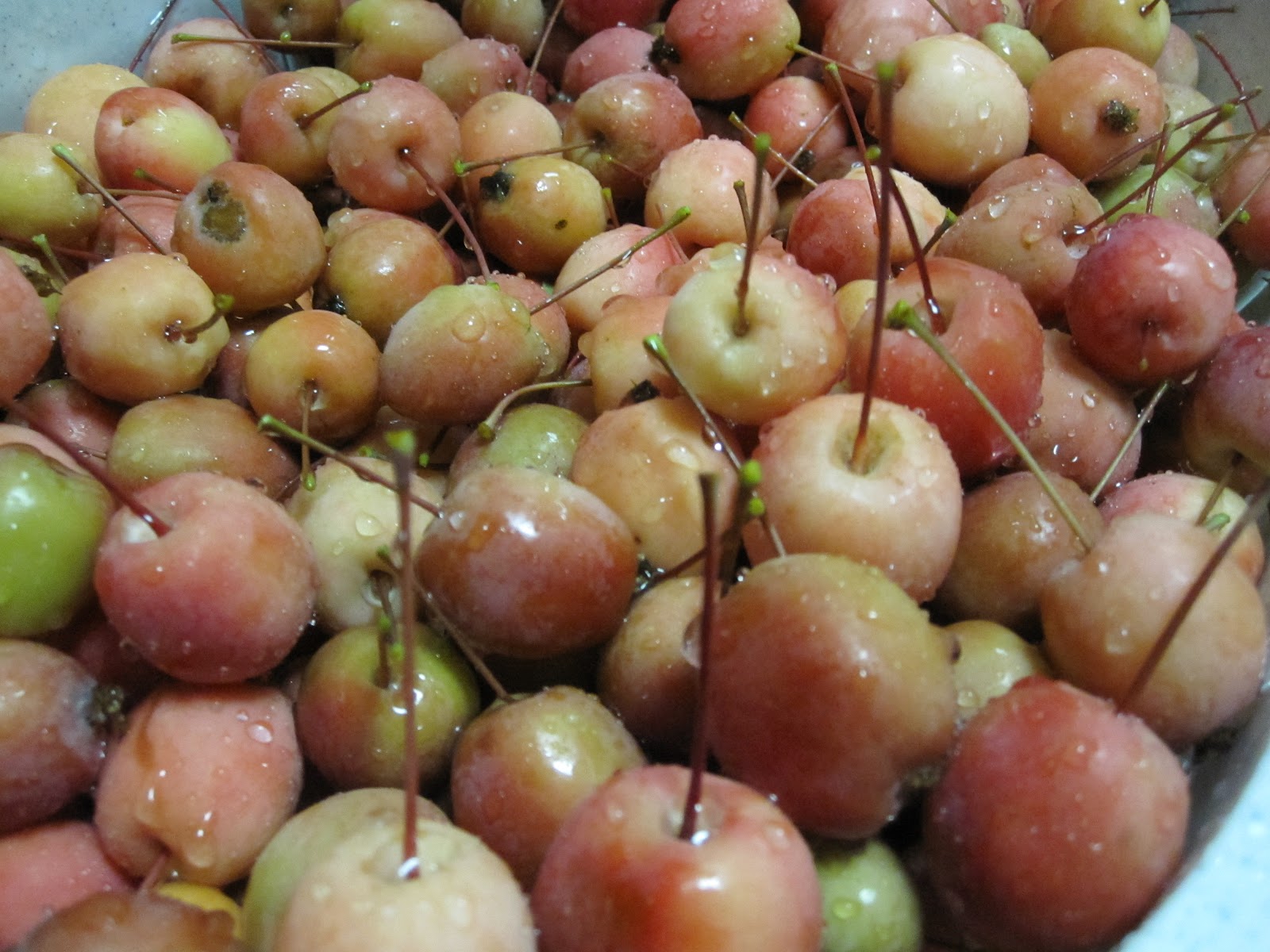
Today, I will relate the events that occurred a few months ago when the trees were bearing fruit, and I happened to be listening to quite a bit of British literature, such as P.G. Wodehouse's Jeeves and Wooster and Jane Austen Novels adapted for radio.  Within those stories, I heard how frugal people would pick fruit from the trees and preserve it for the winter months when fresh fruit was hard to find.  While considering this, I was walking to pick up the mail from our box at our apartment and I began to wonder what kind of fruit trees were in our complex.

I picked one of the globular pinkish fruits and a couple leaves and took them back to my apartment.  I searched on the internet to find a description that matched the fruit I had found.

I discovered that apples are the only fruit with seeds in a star pattern.  They are related to roses and also have serrated leaves.  I compared my samples with the descriptions and discovered that I had several crab apple trees in perfect readiness for harvest.  Crab apples do have an apple-like taste and smell, but are generally a more tart.

So I harvested them.  I made Husband go out with me and hold a bag while I pulled the small apples off the higher branches (using a step ladder, of course).  I brought them home, and washed them thoroughly.  Once they were well washed, I cut them up and boiled them in water.  I squeezed them through a cheesecloth and then used that juice to make crab apple jelly.

The first try I got it into my head that I might not have to use pectin, because after doing a little reading, pectin apparently comes from apples, and other relatives.  However, I must have done something wrong (or my apples just didn't have enough pectin) because the jelly didn't set.  So I boiled it all over again, added pectin this time, and got a quite nice jelly in my re-sterilized jars.


Here's the recipe:

***

Crab Apple Jelly

Crab Apples (about 8 cups?)
Water
1 box Pectin
3 cups sugar

If starting with whole fruit:
Remove stems and leaves.  Cut crab apples in half (or quarters if you have large crab apples) and put them in a large pot.  Pour in enough water to almost cover the apples, but not to make them float.

Bring to a boil and then turn down to medium.  Let cook until the apples change color and are soft.  (You can also use a juicer, if you have one)  Let it cool, then strain the apple mash through a few layers of cheesecloth... you may need to squeeze the juice out.

Measure about 4 cups of juice and put in a pot with 1 box of pectin.  Bring to a boil, then add 3 cups of sugar.  Bring back to a boil and boil for at least 1 minute.

Pour into sterilized jars, leaving 1/4" space at the top.  Put on lids and process in boiling water for 5 minutes.  Remove jars from water bath and let cool, being sure the lids seal and the jelly has set.  Keep in a cool dark place, and these should last for at least a year.

Enjoy!

***

That's it for the recipe.  I must admit that every time I hear "Crab Apples" I think of some sort of strange crab with the body of an apple... then I stumbled across this picture:

and I'm glad that my imagination lines up so well with other people's.

Wednesday, September 15, 2010

Orange Marmalade

I tend to cook more for other people than myself.  Often, once I'm done cooking, I'm no longer hungry for whatever I made.  So I usually check with my husband before I decide to make something that I may, or may not, be interested in eating later.

This allowed me to make the discovery that my husband likes Orange Marmalade.

I will be honest and also say that I was listening to a lot of Jeeves and Wooster by P.G. Wodehouse, and Wooster eats marmalade with his breakfast.

***
Orange Marmalade Recipe

Makes about 6 half-pint jars (I ended up with 7 jars plus a little, but I also used a little more that 4 cups of fruit mixture)

4 Oranges
2 Lemons
2.5 cups Water
1/8 tsp baking soda
6 cups sugar
1 package powdered pectin
1/4 tsp butter (if needed)

It's probably possible to make marmalade without pectin, but after an ordeal with Crab Apple Jelly, I decided to go on the safe side and use pectin.
Clean your canning equipment and jars. Sterilize everything in boiling water. Wash the oranges and lemons, remove the outer peel with a vegetable peeler.  Thinly slice the rinds into smallish pieces and place in a 4-quart saucepan with the water and baking soda.  Bring to a boil, then reduce heat and cover, simmer for 20min, stirring occasionally.  While the rinds are cooking, remove as much white pith from the oranges and lemons as possible.  Finely chop the fruit and make sure to remove all the seeds.
After the rinds are cooked, add  the fruit and juice.  Cover, bring to a boil, reduce heat and simmer for 10min.
Measure 4 cups of cooked fruit and rind mixture, mine was a little over 4 cups, but it still set up fine and I just put the excess in the refrigerator to use now.
Put the 4 cups of fruit into a large pot, add pectin and butter (I didn't use any butter, since mine didn't foam at all).  Bring to a vigorous boil that cannot be stirred down. Boil for 1min.  Add sugar and return to a boil for 1min.  
Remove from heat and let stand 5min, stirring occasionally.
Ladle hot marmalade into sterile jars, leaving about 1/4 inch of space at the top.  Screw on lids tightly and process the jars in boiling water for 5min - make sure the jars are covered by at least 1 inch of water.
Let jars cool undisturbed for 12-24 hours, then check seals. Store in a dark, cool place.


***

The Greeks were probably one of the first to make preserves.  They used a relative of the apple called a quince and cooked it with honey.  When it cooled it would set into a kind of jam. Apples, guavas, quince, plums, gooseberries, oranges and other citrus fruits, contain large amounts of pectin, most have enough to set without using boxed pectin.  Soft fruits like cherries, grapes and strawberries contain small amounts of pectin, which is why we have to add pectin to make them set properly.

I'd love to get my hands on the Book of Ceremonies of the Byzantine Emperor Constantine VII Porphyrogennetos.  It apparently has not only rules about etiquette for banqueting in the 9th Century, but also a catalog of foods and dishes prepared for them.

Fruit preserves, as we know them, came about in the Medieval times, but it usually had spices (not that that's a bad thing).  By the late 1600's there were several recipes for jellies and jams that were just fruit, juice and sugar.  These often include a fruit that has a lot of pectin in it, and a fairly long boiling time.  

www.zazzle.com
For the sake of disambiguation, I use Jam to mean fruit preserve with actual fruit chunks in it (excluding citrus fruits).  Jelly is a clear juice preserve, and marmalade is a citrus preserve.  

However, the word "marmalade" appeared in the English language in 1480.  It derives from the Greek word μελίμηλον (melímēlon), which is made up of "μέλι" (meli), "honey" + "μήλον" (mēlon), "apple".  The Greek word became melimelum, “honey apple” in Latin, which turned into the root word marmelo, "quince" (marmelada in Portuguese, marmelade in French).  The English borrowed the word, presumably, from the French.
(Citations: Wikipedia, Seven Centuries of English Cooking: A collection of recipes by Maxime de la Falaise)